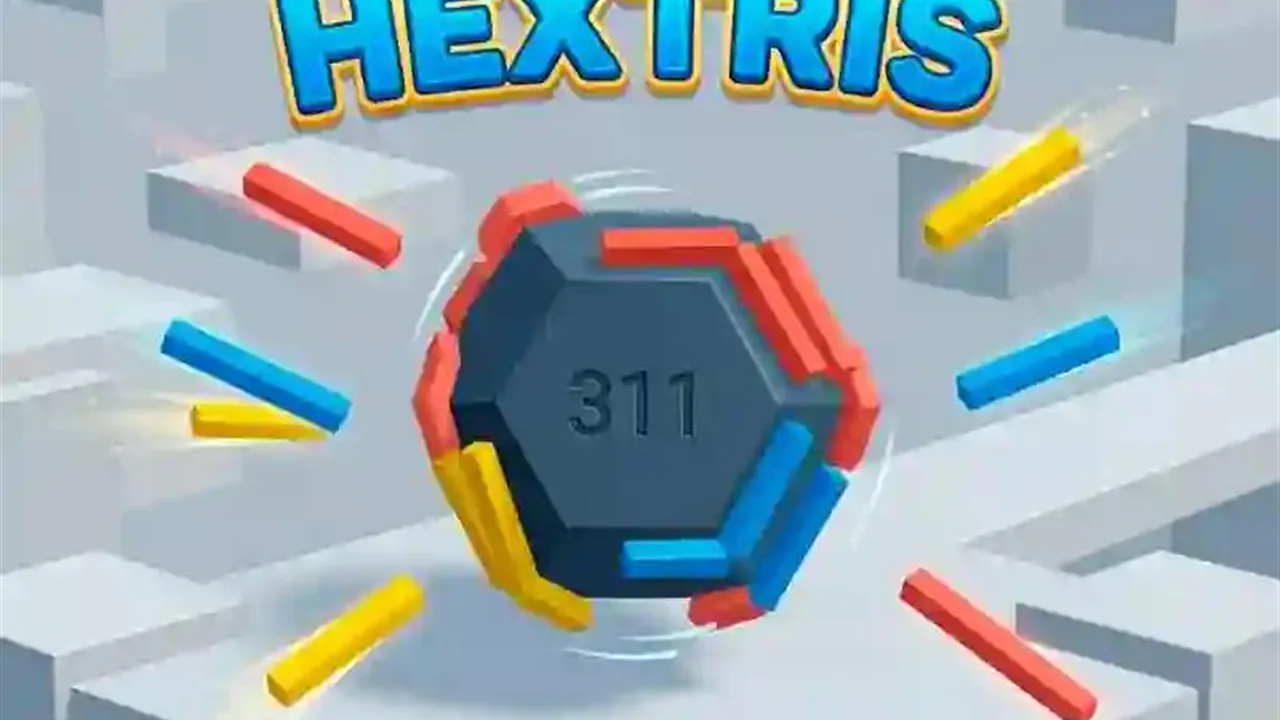
At first, every color seems to have somewhere to go. A few rotations later, one side is suddenly tall. You turn it away, another block lands elsewhere, and the board becomes harder to read while your hands get busier.
Pause the constant turning. Watch one approaching color, then choose which face should receive it.
What are you rotating?
The site's version supports the left and right arrow keys and A/D. On touchscreens, tapping the left or right half turns in the corresponding direction. Test each while the position is simple, before trying unfamiliar inputs at the danger line.
A turn rotates the entire hexagon and its stacks relative to incoming blocks. It does not move one settled block independently. Receiving the current block also changes the positions of the other five faces.
That is why a single-block problem can make the whole board feel unsettled.
Three matching blocks must actually connect
The core rule searches neighboring positions for connected groups of at least three matching blocks. Connections can run through adjacent layers on one face or the same layer on neighboring faces. Looking diagonally close is not enough. Original project
One face, inner to outer: red, red, red
Three neighboring faces at one layer: red | red | red
Both arrangements can connect three. Three reds near one another will not clear together if other colors interrupt their valid connections.
The original guide checked same-face, neighboring-face, wraparound, and diagonal-counterexample relationships in the site's adjacency function. That establishes basic connectivity, not a full scoring or physical-phone test.
Check two things before receiving a block
Can it connect to a matching color? What will receiving it do to the height and difficulty of that face?
Suppose one face ends in two connected reds while another has one red. The three-block opportunity deserves attention, but verify timing and the landing layer. “More red together” can become unhelpful if other colors separate the blocks.
If a nearly full face cannot clear with the arriving block, compare another landing place even if the familiar direction feels easier. A habit can help you learn; treating it as a permanent answer limits your choices.
Do not chase a color around the whole hexagon
Once you identify a target, estimate the turns needed. Repeated corrections make it easier to forget where the other stacks have moved.
Where the position permits, practice making one deliberate decision per block. This is a training constraint, not a game rule. Dense arrivals or a genuinely longer rotation still require adjustment.
Start with the closest arriving block. Look ahead to another once you can handle the first reliably. Do not demand simultaneous calculations of every face, color, and scoring chain at the beginning.
Fitting now is not the whole question
A block fitting somewhere only means that particular placement does not immediately fail. It may bury a matching color and make later work harder.
After a clear, scan the six faces: which is highest, which colors are separated, and which pairs await a third? Familiar patterns gradually replace the need to judge every arrival from scratch.
Study combos and scoring later. First reduce avoidable disorder. Be able to explain a turn and identify a specific mistake when it fails.
Let one loss suggest one exercise
Think back over the last two or three blocks. Did you expect two matching blocks to clear? Misread a diagonal? Turn the wrong way? Recognize a good landing too late? Each suggests different practice.
For adjacency mistakes, watch connections in a slower opening. For directional mistakes, practice left and right inputs. For late-game confusion, inspect whether you keep concentrating pressure on one face.
These placement ideas follow from the rules; they have not been tested for win rate or guaranteed scores. Narrow the next game to one question: before this color lands, can you name the block you want it to touch?