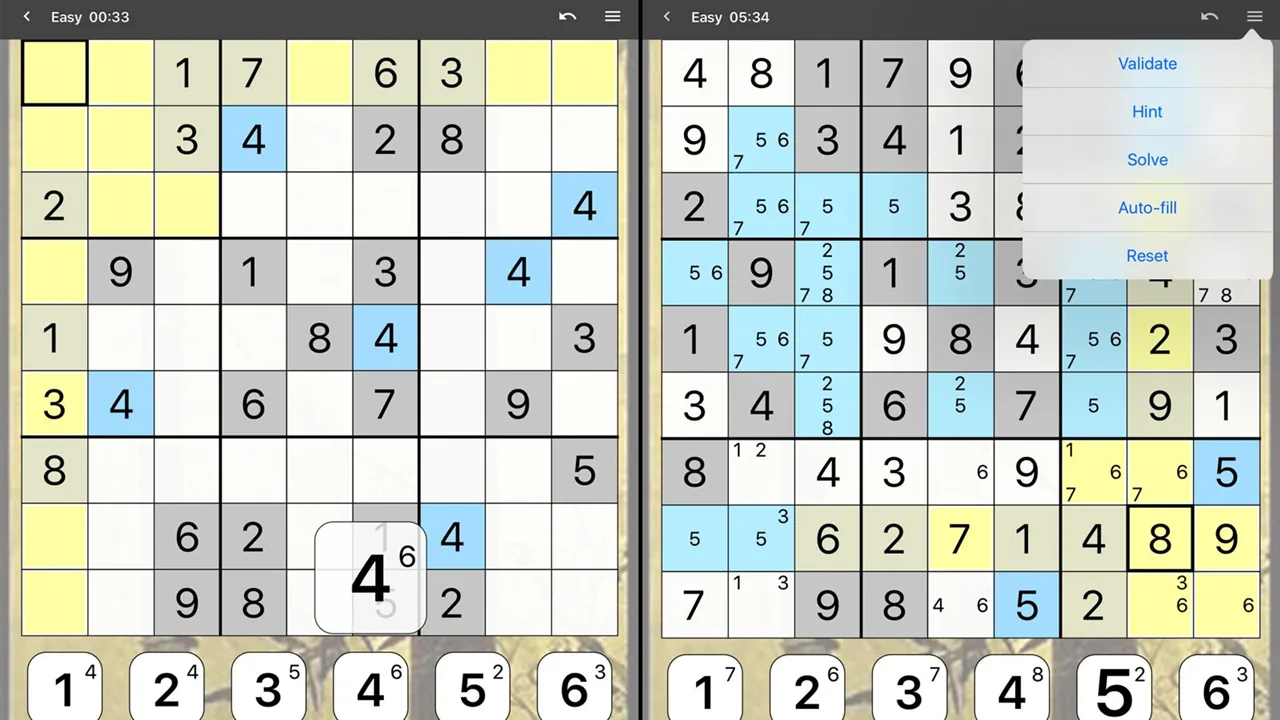
Your eyes travel across the board and back. Every digit is familiar; every cell has been inspected. Nothing moves.
Sometimes the effort is real but the question never changes. Asking only “what goes here?” can hide a deduction visible from another direction.
A player on r/sudoku asks how hidden and naked singles differ. That discussion suggests a useful beginning for our Sudoku: inspect a cell, then follow a number.
Know the three sets of constraints
In standard Sudoku, each row, column, and three-by-three box contains 1 through 9 without repetition. All three matter when checking a cell.
A row with eight filled cells is straightforward. With three missing numbers, each empty cell also needs the column and box exclusions.
Write candidates on paper if useful. Here, candidates mean the possibilities you retain after applying rules. The site's current version has no automatic pencil-mark button; do not search for a feature that is not present.
First question: how many choices remain in this cell?
This is a synthetic candidate exercise, not a game screenshot. Suppose a row lacks 2, 5, and 7. The relevant column already contains 2 and 5. Only 7 remains for the cell, provided the box also permits it and your earlier entries are sound.
The cell looked empty but was constrained from three directions. This cell-first approach finds a single remaining candidate.
Practice with relatively full rows, columns, or boxes. After filling a cell, revisit its affected row, column, and box. New information often appears close to the change.
Second question: where can this number live?
In another independent exercise, a row lacks 2, 5, and 7. Other constraints leave:
| Cell | Candidates |
|---|---|
| A | 2, 5 |
| B | 5, 7 |
| C | 5, 7 |
A seems unresolved because it has two candidates. But the row needs a 2, and only A permits it. Therefore A is 2.
You did not first reduce A to one candidate. You tracked the only available position for 2. The single is “hidden” among candidate sets that individually look unresolved. This table illustrates one row's constraints, not a full puzzle.
The board stays the same. Changing the question reveals a different structure.
Separate the site's red feedback from logical proof
The current implementation retains a generated answer and compares entries with it for immediate error feedback. After removing clues, its code does not additionally verify that the resulting puzzle has exactly one solution. Do not treat every generated board as uniqueness-certified.
Red text therefore does not by itself prove your row-column-box deduction wrong. If feedback conflicts with a complete constraint check, inspect your candidates and consider another board rather than turning trial-and-error into a search for green text.
For training that requires guaranteed unique solutions and full candidate assistance, these are limitations of the present version. Knowing them avoids unnecessary frustration.
Practice two scans next time
Choose a relatively dense unit and ask what remains for each cell. Then fix one digit and ask where it can appear in a row, column, or box. Explain every placement in one sentence.
“It feels right” is a reason to pause. “Every other position in this row excludes 2” is a deduction to retain.
You need not stare harder at the entire board. Read a small area clearly, then ask it another question.