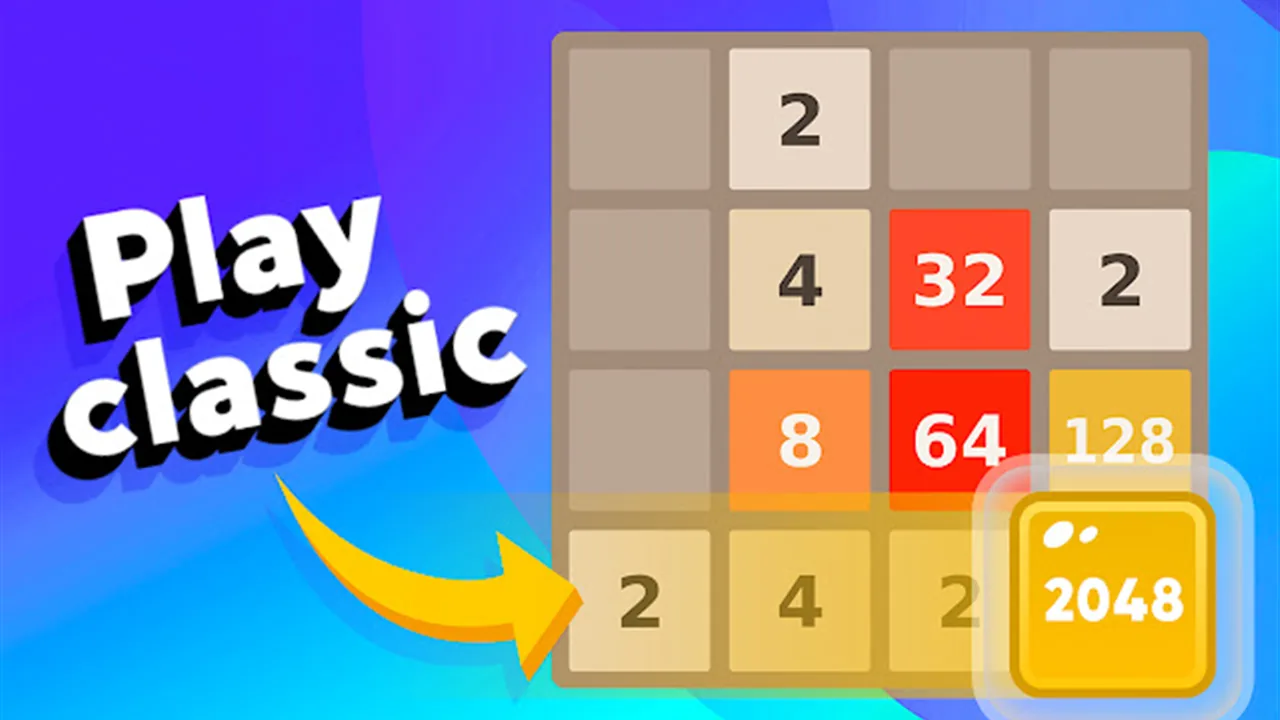
The big tile is still there. The board has nowhere left to go.
It is an aggravating way to lose 2048. You built respectable numbers, chased one more pair, and only noticed the blocked side after swiping.
Try another goal next time: look beyond what this move makes and ask what it leaves available.
What one swipe actually does
Our version uses a four-by-four board. Tiles move in the chosen direction; matching neighbors can merge. A tile created by a merge cannot merge again during that same move.
These examples show the row after movement and merging, before the random new tile appears. Zero means an empty cell.
Before moving left: 2  2  2  2
After moving left:  4  4  0  0
That swipe does not make an 8. Both 4s were just created and must wait for a later move to merge.
Before moving left: 2  2  4  0
After moving left:  4  4  0  0
Again, no immediate 8. Remembering this prevents many moves based on an imagined chain reaction.
A new tile appears after a move changes the board. An empty cell visible before the swipe may therefore be occupied afterward. Original game
A full board is not always a lost board
The target is a 2048 tile. Losing depends on whether any legal movement or merge remains. This full board has no matching horizontal or vertical neighbors:
2  4  2  4
4  2  4  2
2  4  2  4
4  2  4  2
There is no move. Change only the second tile in the first row from 4 to 2, however, and the top-left pair can merge. The board is still full but playable. Count possibilities as well as spaces.
A corner gives the other tiles somewhere to work
Beginners can try keeping the largest tile near a corner, with other large tiles arranged along an edge. This makes the board less chaotic: large tiles stay relatively stable while smaller ones move and pair in the remaining space.
If you choose the bottom-left corner, pause before swiping up. Will it lift the large bottom tiles? After a new tile appears, can they return easily?
This is an organizing habit, not a rule that is correct in every position. Compare other legal moves when your preferred directions trap you. “Try to keep a corner” does not mean “only ever use two directions.”
Look for the next pair, not only the score
Before swiping, ask which pair will merge, which number its result could approach next, and what choices remain if the random tile lands awkwardly.
An empty cell does not permanently separate these two 2s:
Before moving left: 2  0  2  4
After moving left:  4  4  0  0
They slide together before merging. Imagine the whole row after movement, rather than searching only for pairs already touching.
A row of “4, 2, 0, 0” does not change when moved left. In this version, an input that changes nothing anywhere on the board does not generate a tile simply because you pressed a direction. A stationary row does not imply a stationary board, though; inspect all four rows.
Understand where space comes from
Two tiles becoming one frees a cell. A valid move then introduces one new tile. If a swipe produces exactly one merge, the new tile cancels that extra space. Two merges followed by one new tile leave one more empty cell overall.
That is why merging can still leave the board crowded. Watch the whole position, not just the growing number.
More space usually offers flexibility, but space is not the only objective. Temporary crowding can be worthwhile if it sets up a clear next merge. Know what you are exchanging.
Practice one prediction
Do not demand corner control, a perfect snake pattern, and probability estimates at once. In the next game, predict one row before every swipe. Compare the prediction with the result.
When wrong, identify the cause. Did you forget movement happens before merging? Did you allow a newly formed 4 to merge twice? Once row predictions are reliable, expand to the board.
Before restarting a lost game, inspect the largest tile. Which small tiles isolated it? Did chasing one pair send another potential pair farther apart? A specific decision gives you something to change.
The original guide checked the site's core code and seven controlled positions, replacing random tile generation for movement checks and separately checking two full boards for available moves. This is not a phone-play score or evidence of a strategy's win rate.
Next time, wait half a second. See where those two 4s will end up before your finger moves.