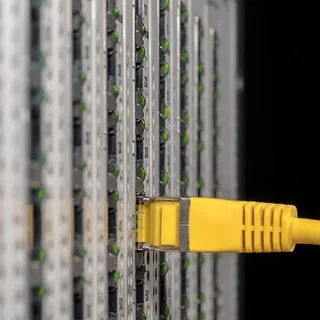
The visible part of AI is a screen: a question, an answer, a shorter wait. Beyond it operates a slower system. Power stations, substations, transmission lines, and cooling equipment must keep working behind each request.
Expansion brings questions beyond model capabilities: where to build, how to connect, and who funds the additional infrastructure.
Read the demand number carefully
The International Energy Agency's executive summary for *Key Questions on Energy and AI* estimates global data-center electricity consumption rising from about 485 terawatt-hours in 2025 to about 950 in 2030. The latter is a forecast, and the category is all data centers—not electricity attributable solely to AI. IEA executive summary
Data centers support other digital services too. AI is an important source of growth, not the entire category. Deployment, efficiency, equipment supply, and adoption affect the forecast. It is not an electricity bill already paid.
Even as a conditional estimate, it poses a concrete question: can planned loads and deliverable electricity infrastructure arrive on compatible schedules?
A data-center address is also a position on the grid
The following is editorial analysis informed by the report.
Servers inside a building do not establish that the local grid can support their demand. Transmission capacity, equipment lead times, permits, and construction have their own constraints. A commercial expansion timetable may not match an infrastructure timetable.
Proximity to customers, suitable land, and good communications are only part of site selection. Reliable power, connection time, and changing supply costs may influence where a project ultimately goes.
These limits bring geography back into digital investment. Online services appear borderless; their equipment and energy occupy particular places.
Does extra demand mean higher household bills?
New consumption alone cannot answer this for every region.
The same IEA summary discusses how price effects depend on supply and demand, investment, and cost allocation. A constrained system may need more construction; one with spare supply may use existing facilities more fully. Concentrated, rapidly growing data-center demand with uncertain actual loads can also create mismatches between investment and use.
Ask how much capacity a project requests versus expects to use, whom new lines serve, and what happens to invested costs if projected demand fails to arrive.
There is no universal one-line answer. Local planning, company commitments, and charging arrangements help determine the outcome.
Efficiency and rising total demand can coexist
Using less electricity per computation and performing many more computations are compatible.
Imagine a service lowering energy per task while attracting more users and uses. Total consumption depends on both changes. This is a hypothetical explanation, not a measurement of a company.
Ask “How much per task?” and “How many tasks?” An efficient technique alone cannot prove falling aggregate demand. Rising aggregate demand alone cannot prove that efficiency has not improved.
AI also enters the electricity system
The report discusses possible uses in equipment monitoring and grid optimization, alongside limits involving data, skills, and security. The relationship is not only electricity flowing toward servers.
Potential needs conditions: adequate data, reliable operation in the real setting, and someone responsible for reviewing recommendations. “AI” in a product's name does not remove the need to validate results.
What to watch next
Beyond announced investment totals, watch the time from announcement to grid connection, delivery of promised capacity, disclosure of actual loads, and whether cost arrangements are understandable to users and local residents.
Such details attract less attention than launches but help determine whether a digital service can operate reliably over time. A model may answer faster while a transformer is still awaiting delivery.
The next time you read about expanding computing capacity, look a little farther behind the screen: where is the building, where will its power come from, and who connects the line?