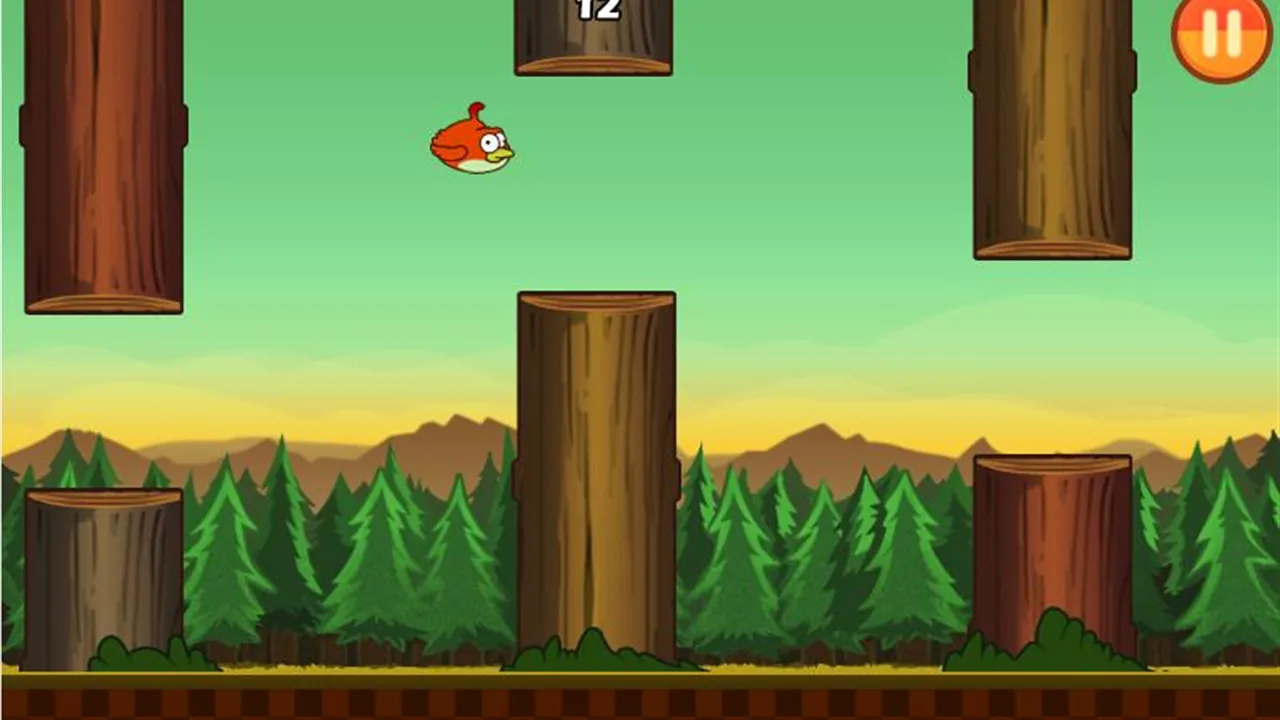
The pipe approaches. The bird is falling. One tap, then another because the first did not seem enough. It rises straight into the top of the opening.
After restarting, the last tap is easy to blame. But an earlier hesitation may have created the situation. A game with few inputs can still demand careful decisions.
What does one tap change?
In this site's version, Space and pointer clicks trigger flight input; touchscreen taps use that input path too. A valid flight action pushes upward; without it, downward motion continues. Hitting a pipe, the ground, or the upper boundary ends the round. Creator's project
More taps are not automatically better. You manage height and direction of motion: rising or falling, how quickly, and how much room the next input leaves.
These rules were checked in the site's core code. They do not establish a universal rhythm for all devices.
Watch one rise and fall
When the opening allows observation, watch the rise after a tap and the descent without another. Do not immediately add taps to force perfectly level flight.
A steady rhythm can build familiarity, but pipe openings can change. A permanently memorized beat may make necessary height changes slower.
Keep your finger somewhere comfortable rather than chasing the bird across the screen. The object you watch moves; your input hand need not follow it.
Reach a useful height before the opening
A major correction at the pipe's edge leaves little time. Read the next opening earlier, approach a passable region, then make smaller corrections.
Aim near the middle as a beginner's margin, not a frame-perfect optimal route. Account for your current rise or descent and the opening beyond it. Being centered while falling fast differs from passing through the center slowly.
Watch where the last input is taking you, not only where you are now.
Separate three common errors
Late correction: you are already near the lower edge, then tap repeatedly to recover. Try managing height earlier rather than adding more last-second taps.
Excess correction: the first input was sufficient, but a second worried tap sends you into the upper edge. Practice observing the first response before adding another.
Near-sighted attention: you are still checking the pipe just passed while the next opening arrives. Shift attention forward without forgetting an obstacle you have not fully cleared.
One failure may combine these. Choose the earliest, easiest-to-change issue rather than writing an elaborate diagnosis of the whole round.
Spend five rounds on one question
For a short practice set, record whether each failure was high, low, or an input that did not respond as expected. Set the score aside.
Mostly high collisions suggest inspecting repeated taps. Mostly low ones suggest checking how late correction begins. The pattern gives a direction, not a confirmed cause; connect it to the preceding inputs.
If a tap appears ignored, check input focus, page overlays, and obvious browser stuttering. Technical and player-control problems require different explanations.
Keep one reusable action
More pipes are satisfying. Another useful result is recognizing a familiar height problem earlier than before.
That observation cannot guarantee a new record. Position, device state, and attention affect performance. A mistake need not become a verdict on yourself.
Before restarting, name one change: “Wait before adding the second tap” is more workable than “Be much better this time.” Now your next touch has something specific to practice.